Procurement Framework

How to Evaluate Peptide Quality & COAs

In analytical chemistry, quality is defined by verifiable data rather than marketing slogans. When sourcing reference compounds, qualified laboratories evaluate four distinct markers:

1. Chromatographic Purity (HPLC)

High-Performance Liquid Chromatography measures what percentage of the sample is the target compound versus degradation artifacts.

2. Identity Confirmation

The laboratory confirms that the compound in the vial is the compound named on the label. Each lab report names the method it used.

3. Net Peptide Content

Distinguishes the true weight of the peptide from residual counterions (trifluoroacetate or acetate salts) and bound moisture.

4. Endotoxin (USP <85>)

Measures bacterial endotoxin in endotoxin units (EU). When a lot is tested for it, the result is shown exactly as the laboratory reports it, so you can judge whether it could interfere with cellular assays.

Shared Testing

Proud member of the COA Coalition

We joined the COA Coalition because we believe independent testing should not be a luxury. Member vendors buy together and share the cost of third-party testing. Every batch is still tested by an independent lab, and the savings go into your price.

Independent labs

Batches are tested by third-party labs such as Freedom Diagnostics, Janoshik and ILS.

Traceable

The batch number on your vial matches the batch on the report, and you can verify the report with the lab.

Better value

Shared testing costs mean lower prices on our extended selection.
Two ways a batch is tested

Ashen ResearchCOA Coalition
Report issued toAshen ResearchCOA Coalition
How the batch is testedSent by us to an independent third-party labSent to an independent third-party lab through the Coalition, with the cost shared among member vendors
Tested on every batchIdentity, purity, and net contentIdentity, purity, and net content
How to verifyThe lab's own verification link, on every lotThe lab's own verification link, on every lot, plus our Coalition member page
Verify coalition membership

Endotoxin, Sterility & Heavy Metals: What They Are and When They Matter

Identity, purity, and net content are the checks every lot we sell must pass (blends are the one exception on purity, explained below). Endotoxin, sterility, and heavy-metal (elemental impurity) testing are valuable additional checks that are not run on every lot: when a lot has been tested for any of them, the result is shown with that lot. This guide explains what each test is, what it can and cannot tell you, and how researchers typically use them. It is educational, based on the public sources listed below, and is not guidance for use in people or animals.

What is endotoxin?

Endotoxin is lipopolysaccharide (LPS), a molecule from the outer wall of Gram-negative bacteria. Because it is part of the bacterial wall rather than a living organism, a material can still contain endotoxin after steps that remove or kill living bacteria.[3][5]

How is endotoxin measured?

The standard approach is the bacterial endotoxins test (BET). In the common version, the Limulus amebocyte lysate (LAL) assay, a sample is mixed with a lysate made from horseshoe crab blood cells, and a measurable reaction (such as clotting, turbidity, or a color change) signals endotoxin. FDA has accepted LAL for decades in place of the older rabbit test, and the compendial method is described in USP chapter <85>.[1] Reagents based on recombinant factor C are recognized as an alternative that avoids animal-derived lysate, provided they are shown to be equivalent.[2]

Results are reported in endotoxin units (EU), either per milligram or per vial. To compare a per-vial result with a per-milligram one, divide the vial result by the net content in milligrams.

Why does endotoxin matter for in vitro work?

Cells, especially immune cells, can respond to very small amounts of LPS. In one published study, concentrations between 0.002 and 2 ng/mL stimulated monocytes and dendritic cells, and the residual endotoxin found in commercially supplied recombinant proteins was enough to activate a sensitive cell system.[3] Cell-culture application notes make the same point: endotoxin can disrupt experiments, particularly those involving immune cells, and can also change the behavior of non-immune cells, which is why routine LAL testing of reagents is recommended.[4]

In short, an endotoxin result helps you judge whether a reagent could be adding an unintended signal to a cell-based assay.

How do I read an endotoxin result on a COA?

Check four things: the unit (EU/mg or EU/vial), the sample name and batch, the test date, and the reported value. Lower is better, and the level that is acceptable depends on how sensitive your assay is. We show the endotoxin result exactly as the laboratory reported it, in the unit the laboratory used. The How to Read a Certificate of Analysis guide below walks through a sample endotoxin report.

What is sterility testing, and how is it different?

Sterility testing checks whether a sample contains viable microorganisms such as bacteria, yeast, or mold. For drug products that are labeled sterile, U.S. regulations call for laboratory testing of each batch.[5] A sterility result and an endotoxin result answer different questions: sterility is about living organisms, while endotoxin is a chemical contaminant that can remain after organisms have been removed or killed.[5]

Sterility testing is not part of every lot's report, and Ashen Research materials are not represented as sterile products. We do run sterility testing periodically, as described below.

How do labs handle sterility for solutions?

In cell culture and other in vitro work, it is routine to use aseptic technique and to sterile-filter solutions at the point of use. In FDA terminology, a sterilizing-grade filter is one that reproducibly removes microorganisms and usually has a rated pore size of 0.2 micron or smaller.[5][6]

Filter choice matters for peptides. Manufacturer guidance recommends membranes sold as low protein-binding for protein and peptide solutions, commonly polyethersulfone (PES) or hydrophilic PVDF, because protein binding to the membrane can reduce how much reaches your sample.[7] This describes general laboratory practice for preparing solutions for experiments.

Does filtering remove endotoxin?

No. Filtration retains microorganisms; it is not an endotoxin control. FDA's guidance on aseptic processing notes that sterilizing-grade filters and moist-heat sterilization have not been shown to be effective against endotoxin, which is why endotoxin is controlled and tested separately.[5] That is one reason an endotoxin result is useful even if you plan to filter your solutions.

What are "heavy metals," and how are they tested?

"Heavy metals" is an older term. Current pharmacopeial practice refers to elemental impurities such as lead, cadmium, arsenic, and mercury, measured with inductively coupled plasma techniques (ICP-MS or ICP-OES).[10] USP chapters <232> (limits) and <233> (procedures), aligned with ICH Q3D, replaced the older USP <231> heavy-metals test.[8][9]

Do those standards apply to research materials?

Those documents set limits for finished drug products: ICH Q3D states that it applies to new finished drug products, and its limits are permitted daily exposures for drug products.[8][9] They do not set limits for research reagents, so for research materials elemental testing is a quality check chosen by the supplier or the researcher rather than a regulatory requirement. Whether it matters for your work depends on your application. If your protocol is sensitive to trace metals, you can have a sample tested by an accredited laboratory, or contact us.

When does Ashen Research run sterility and elemental testing?

Identity, purity, and net content are required for every lot. When a lot is also tested for endotoxin, that result is shown with the lot. Sterility and elemental (heavy-metal) analysis are also meaningful quality checks; they are routine for finished drug products because regulations call for them there.[5][8][9] They are not part of every lot's standard report. When a lot has been tested for sterility or heavy metals, those results are shown with the lot. If you have a question about a specific lot or supplier, contact us.

Which tests should I look for?

It depends on your assay. Identity, purity, and net content tell you what is in the vial and how much, and endotoxin matters most for cell-based work, especially with immune cells (see above). Identity, purity, and net content are the baseline we require for every lot, and an endotoxin result is shown whenever a lot was tested for it. Sterility and elemental analysis are valuable additional checks. Sterility is usually handled at the bench with aseptic technique and filtration, keeping in mind that filtration does not address endotoxin and can cost you peptide if the membrane binds it. Elemental analysis is worth requesting if your protocol is sensitive to trace metals; when a lot has been tested for it, the result is shown with that lot.

Why do blends sometimes not have a purity number?

A blend contains more than one compound, so a single purity percentage can be ambiguous: it is not clear which compound the number would describe. Reporting practice varies by laboratory, and some labs report the amount of each component instead of an overall purity figure.

When a blend's report has no purity number, we show "Not reported" for purity and list each component's result on the product page. For those lots, check that identity is confirmed and that each component's quantity is within its specification.

Does passing these tests make a research material suitable for use in people or animals?

No. These tests describe the quality of a research material. Research materials are not manufactured, tested, or released to pharmaceutical standards, and no combination of the tests above changes that. Ashen Research products are supplied strictly for in vitro laboratory research.

How to Read a Certificate of Analysis

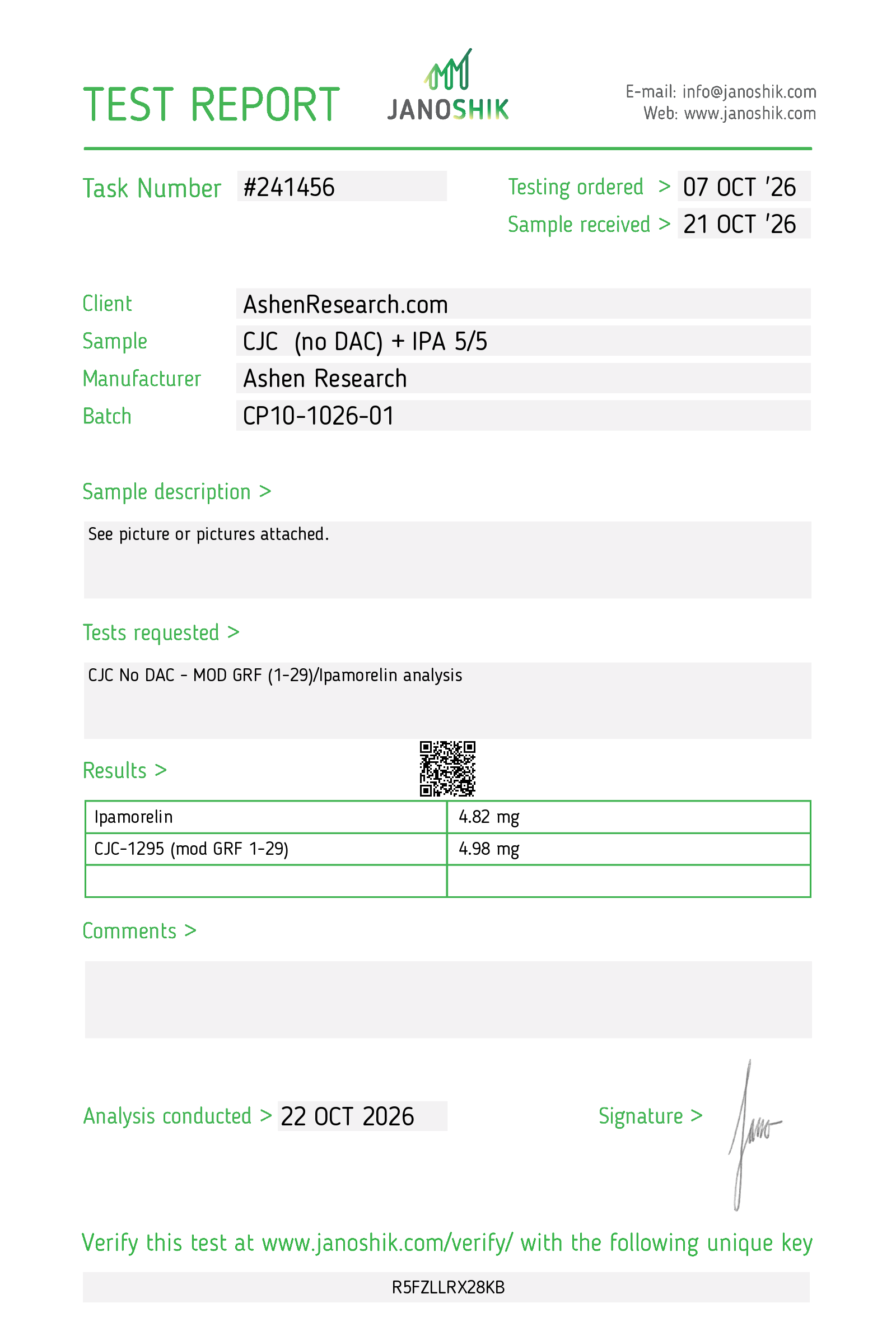
Every lot is tested by an independent laboratory, and the lab's own report is published with it. Here is what the key parts of a report mean, so you can check our numbers against the source yourself. Hover over a numbered item to see where it sits on the report.

Report 1: Identity, Purity & Net Content 1 2 3 4 5

Sample report shown for illustration. The client, batch, and values on the COA for your lot will differ. Open full size

Report 1: Identity, Purity & Net Content

Sample report: a CJC1295 (no DAC) 5mg + Ipamorelin 5mg blend

  1. 1
    Date tested

    The day the lab actually ran the analysis. It should be recent relative to the batch, so the result describes the lot you are buying rather than an old one.

  2. 2
    Batch / lot #

    Ties the report to one production lot. Match it to the batch number on the product page and on your vial label. If they differ, the report is not for your lot.

  3. 3
    Identity & Purity (blend)

    The compound the lab detected and named in the vial. Confirm it matches the product you ordered; some compounds list their components separately. If purity is reported, the percentage of the sample that is the target compound, measured by HPLC. The rest is impurities. Higher is better, and we only list lots that meet our minimum. Compound blends like CJC+Ipamorelin may not show purity numbers as some labs, like Janoshik, do not report purity for blends.

  4. 4
    Identity

    The identity of additional compound(s) in the blend.

  5. 5
    Net content

    The measured amount of actual peptide in the vial, in milligrams. Compare it with the label amount. It can read lower than the total powder weight because vials also contain salts and moisture.

Report 2: Endotoxin 1 2 3 4

Sample report shown for illustration. The client, batch, and values on the COA for your lot will differ. Open full size

Report 2: Endotoxin

Sample report: a CJC1295 (no DAC) 5mg + Ipamorelin 5mg blend

  1. 1
    Date tested

    The day the lab actually ran the analysis. It should be recent relative to the batch, so the result describes the lot you are buying rather than an old one.

  2. 2
    Batch / lot #

    Ties the report to one production lot. Match it to the batch number on the product page and on your vial label. If they differ, the report is not for your lot.

  3. 3
    Sample name

    The product and vial size the lab was given. Check that it names the same compound and amount as your product.

  4. 4
    Endotoxin level

    Endotoxin is a bacterial contaminant measured in endotoxin units (EU); lower is better. Labs report it per vial or per mg. A per-vial result divided by the vial's content in mg gives the per-mg figure to compare against our limit. In this example, Janoshik reports it per vial, so the per mg result is 3.4 EU/mg.

Cart

Your cart is currently empty.

Subtotal$0.00
Proceed to Checkout